Songs for Parkinsons Warriors 2025 ND Celebration

Stand Up for Singapore

Stand up for Singapore, do the best you can
Reach out for your fellow man, you’ve got to make a stand
Recognise you can play your part
Let it come right from your heart
Be prepared to give a little more
Stand up, stand up for Singapore

Stand up for Singapore, do it with a smile
Stand up for Singapore, you’ll find it all worthwhile
Believe in yourself, you’ve got something to share
So show us all you really care
Be prepared to give a little more
Stand up, stand up for Singapore

Singapore our home and nation
Together with determination
Join in like we’ve never done before
Stand up, stand up for Singapore

Count On Me, Singapore

We have a vision for tomorrow
Just believe, just believe
We have a goal for Singapore
We can achieve, we can achieve

You and me, we’ll do our part
Stand together heart to heart
We’re going to show the world what Singapore can be
We can achieve, we can achieve

There is something down the road that we can strive for
We are told no dreams to go that we can try for
There’s a spirit in the air
It’s a feeling we all share
We’re going to build a better life for you and me
We can achieve, we can achieve

Count on me Singapore
Count on me to give my best and more
You and me, we’ll do our part
Stand together heart to heart
We’re going to show the world what Singapore can be
We can achieve, we can achieve

Count on me Singapore
Count on me to give my best and more

You and me, we’ll do our part
Stand together heart to heart
We’re going to show the world what Singapore can be
We can achieve, we can achieve

Count on me Singapore
Count on me to give my best and more
Count on me Singapore

Count on me Singapore
Count on me to give my best and more
Count on me Singapore

Count on me Singapore (We can achieve, together Singapore)
Count on me Singapore (We can achieve Singapore, my best and more)
Together Singapore, Singapore

Singapura NDP Song actions

Singapura, Oh Singapura
Sunny island set in the sea
Singapura, Oh Singapura
Pretty flowers bloom for you and me
Come along join the song in merry singing
Blend your voices, join in the chorus
Singapura, Oh Singapura
Pretty flowers bloom for you and me

Singapura, Oh Singapura
Sunny island set in the sea
Singapura, Oh Singapura
Pretty flowers bloom for you and me
Come along join the song in merry singing
Blend your voices, join in the chorus
Singapura, Oh Singapura
Pretty flowers bloom for you and me

Chan Mali Chan

Di mana dia anak kambing saya?
Anak kambing saya yang makan daun talas
Di mana dia buah hati saya?
Buah hati saya bagai telur dikupas
Chan mali chan, chan mali chan,
Chan mali chan, ketipung payung (2X)

Di mana dia anak kambing tuan?
Anak kambing tuan di atas jambatan
Yang mana dia bunga pujaan?
Si bunga tanjung dihujung dahan
Chan mali chan, chan mali chan
Chan mali chan ketipung payung (2X)

Coding With Chinese Characters

In the post Creating Secure Passwords and PINs Easily, mention is made that Chinese characters may be used to represent our constant.  For our purpose, Chinese characters represent numbers in two ways.  One is stroke count and the other is the 4 digits from the 4-corner dictionary code.  For example,Examples 1

The 4-corner code has the advantage in that the 4 digits will come to mind quickly once you are familiar with the system.  I would like to give more ideas on how we can use it for our purpose.

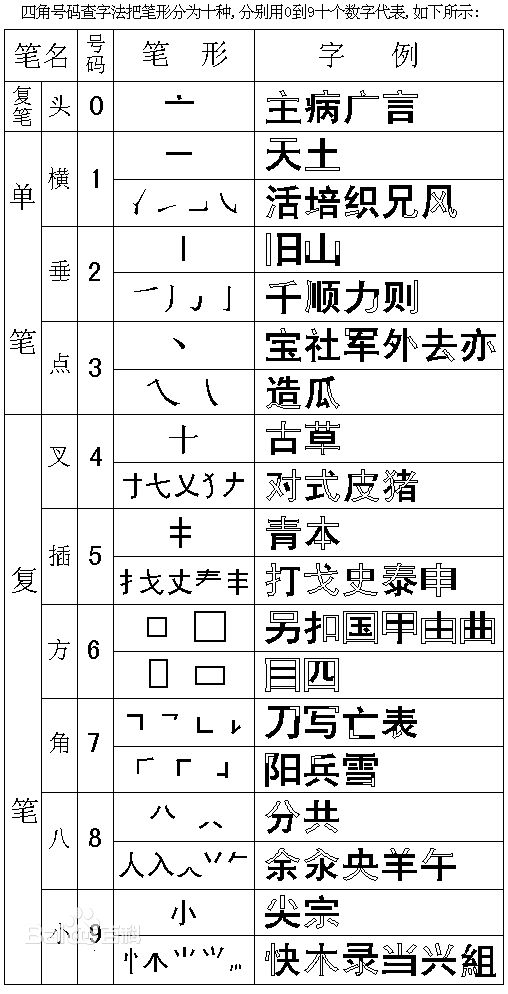
First, a reference chart on the 4-corner code or the 4-corner numbers character lookup system (四角號碼檢字法):

10StrokeWang

10StrokeWang0Source: http://geostroke_abc.tripod.com/ChineseDigitalResearch.html)

This one for download into mobile phones for reference:

4-corner code

For those new to this system, there are many sites they can learn from.  These are some of them:

http://dict.variants.moe.edu.tw/fulu/fu13/fubiau/four.htm

http://baike.so.com/doc/5430747-5669032.html

http://baike.baidu.com/view/67253.htm

http://www.baike.com/wiki/%E5%9B%9B%E8%A7%92%E5%8F%B7%E7%A0%81

This site gives the 4-digit numbers when you input the characters:

http://sijiao.118cha.com/

When I introduced this method it was in the context of using a Chinese character or two to represent the constant.    Actually, we can use Chinese characters for variables too.  However, to ensure that there is a mix of alphanumeric characters, we cannot have both the constant and the variables represented by Chinese characters for passwords.  (There is of course no such constraint in the case of PINs.)

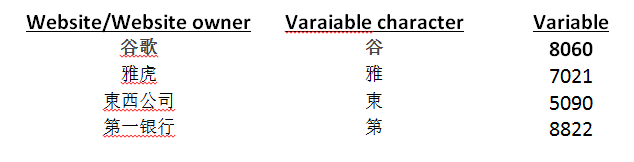
I would like to advocate this strategy for those who read Chinese.  Construct your constant to contain alphabets and use Chinese characters for the variables.  The list of variables you keep will thus consist of Chinese characters.  If you go one step further, if the Chinese characters come from the Chinese names of the websites or the organisations to which the websites belong, you can even dispense with keeping a list.  For example:Examples 2

In the above examples, I use the first character of the name as my variable character.  This is a rule I have set to apply in all cases.  With this I can dispense with the need to keep a record of the variables.  You can of course set a different rule, such as, taking the last character instead.

The 4-corner code system was first publicized in the 1920s by Wang Yunwu (王雲五), the editor-in-chief at Commercial Press Ltd, China.  There is now a fifth digit added to take account of certain stroke inside the character.  There are also variations of the system adapted for some specific uses, see  http://geostroke_abc.tripod.com/ChineseDigitalResearch.html.

All these systems are meant for dictionary listings of the characters.  For our purpose, we just want the number codes and this system suits us to a T.

In conclusion, I would like to point out that this website will probably be known to hackers and cyber thieves.  They will take note of this method.  The primary strength of this method lies in the constant.  We must make sure that it is never compromised and never something they can guess.

Other Ways of Converting Words to Numbers

Two ways of converting words to numbers are pointed out in the post Creating Secure Passwords & PINs Easily (para 8 and 14).  In this post, I’m showing three more ways of doing it.

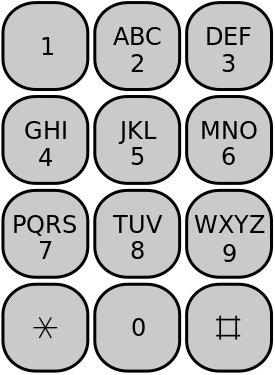
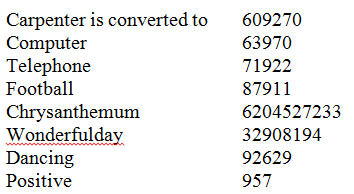
First, we can use the telephone keypad configuration, with the numbers 2 – 9 associated with letters of the alphabet as shown:

For example, “honesty” will be represented by 4663789.

The easy availability of the telephone makes this a very convenient way.  One shortcoming is the non-occurrence of ‘0’ and ‘1’ in the numbers.  However, this may be turned into an advantage.  Insert them into the numbers to serve as red herrings.

The second way is the system used in mnemonics (memory techniques) to remember numbers.  The phonetic number system uses consonant sounds to represent the ten digits as follows:Phonetic syst

W, h, y and the vowels have no value.  They are, however, needed for words to be made. ‘h’ modifies the values of ‘c’, ‘s’, and ‘p’ if it comes immediately after these letters.

In mnemonics, numbers are converted to words and a memorable story or sentence is made up containing those words.  The story/sentence will help the words to be recalled and thus the number they represent.  In applying this system, the pronunciations and the sounds are what determine the values and not just the letters per se.  Hence there are rules concerning silent letters, double letters and on dealing with the letter ‘x’ due to peculiarity of pronunciations.  For a better idea, please seehttp://www.memorizeeverything.com/core_skills/numbers/

The advantage of using this method, sometimes referred to as the major system, is that there is no counting involved.  When we look at the word, the number it represents will come to mind immediately.  Some amount of practice is required.  What it requires is a good understanding of English pronunciations.

The third method I am introducing is an adaption of the phonetic system to help those who have difficulty with English pronunciations.  Instead of sounds, we can devise a system based on the shapes of the numerical digits and the alphabets.  Here is an example:Shapes of letters system

Some examples: Here, all the letters, other than the vowels, have values.Examples

You can see that it is quite easy to get a hang of it and the number comes very quickly.  This adaptation also suggests that we can create our own codes.  If you assign a different value to some of the letters, and it is quite easy to rationalize for them, you would have your own unique code.  For example, you may also give values to the vowels as well, such as,Nos for vowels

Any variation will raise the odds against hackers and this will indirectly make the system stronger for everybody because the hacking program will have to deal with additional factors.

Red Herrings

This blog is for the purpose of sharing a method of creating passwords and PINs that are easily recalled yet not easily hacked.  Unfortunately, this blog will also be read by hackers.  A well thought out and well-protected constant is perhaps the best defence.  There may be other strategies that can help make life more difficult for hackers.  I would like to offer a few here.

First, let’s look at the listing of variables.  Some may not be comfortable with the idea of putting the variables in a list.  It may be seen as a give-away.  But, think about it, it can also be used to mislead hackers.  Here are some of the ways to do it:

  • Only the first, say, 5 letters of the variables are applicable.  For example, the variable “I am a great guy”.  It becomes “mgrtgy” when the vowels are left out.  The real variable is “mgrtg”, the first 5 letters.  It can of course be the last 5 letters instead.   Also, instead of 5, it can be 3 or 4, or whatever.  Set your own rule and apply it to all cases.
  • List some of the letters in CAP, like “I am a GReat guy”.  The uppercase letters may only be a deception and do not mean anything.  Or, it may mean there is an uppercase letter somewhere.  Again, set your own rule what it means, i.e. the letter at which position shall be in the uppercase.
  • Make some exceptions to the rule of dropping the vowels.  Two examples of what we can do:
    1. Only vowels in one part of the constant-variable components are left out   
    2. Only certain vowels are dropped.  For ease of application, keep only one, the rest are dropped
  • If you know the written scripts of another language other than English, you can add a few such other language scripts in your entries.   For example, I can add the Chinese character for flower to my entry of “beautiful” to become “beautiful 花”.  It may be partly or fully significant, or not at all.  If it is to be significant, you can encode it as follows:
    1. 8 by stroke count
    2. 4421 by the 4-corner dictionary code
    3. 11 by adding  the 4 digits in “4421”
    4. 4 by recognizing only the first digit in “4421”


So “beautiful花”can be any of these:

  • Btfl (the Chinese character is only a red herring)
  • btfl8
  • btfl4421
  • btfl11
  • btfl4
  • 4421 (when there is a Chinese character, ignore the English word)


Second, change the CONvariablestant format.  I can mix the components about like these:

  • CONvariablestant
  • variaCONstantble
  • CONvstantariable
  • Cvariableonstant, etc


Third, encode one part of the constant + variable components into a number.  The main article suggests two ways to do it.  The letter positions in the alphabet method (para 14) can be used to convert both the constant and the variable.  The number counts of the letters in the words method (para 8) is suitable for a memorable phrase.  We can always use this method to create statements even referring to the particular website/portal so that it is easier to construct and remember.  Here are some examples:

  • I like to bank with Hongkong Shanghai Bank – (convert to 14244884)
  • We can get good bargains on ebay – 2334824
  • com is my favorite online store – 922865
  • Thanks Google for Gmail, I can communicate with the world – 66451311435

Again, to make it more difficult for hackers, use only, say, the first 4 or 5 digits (similar idea to bullet point 1 in para 2 above). 

The above examples are essentially to make the method more hack-proof even when the hackers know the method.  As for applying the system, we will have to set our own rules so that we know exactly what to do when we have to think of a password and then when we need to recall it.  I have given several examples how to go about encoding the passwords but you have only need to decide on one combination of two methods – one for the constant and one for the variables – and use just this one combination throughout.   This is to prevent confusion and uncertainty when you have to recall them.

I would like to invite contributions from readers if they have other strategies to do encoding.  The more varieties of ways there are, the more we are making the job of hacking difficult.

The more we share, the more we gain!

Creating Secure Passwords & PINs Easily


Are you using one of those passwords that are described as weak here? http://www.pcworld.com/article/187354/Study_Hacking_Passwords_Easy_As_123456.html

2         Or, you have difficulty creating new passwords when you need to?  Unfortunately we cannot avoid it if we want to keep up with the world.  Passwords and PINs are really controlling much of our lives nowadays.  So much of our work these days, both for business and for personal matters, are carried out on the computers and through the Internet.  It means we have to cope with more and more passwords and PINs.

3          Many of us end up using weak passwords because we are always reminded not to write down the passwords but it is impossible to remember all the passwords if we are to also observe the rule that we must have different passwords for different systems/web portal.  Here is a method to help overcome the problem.

A simple principle to follow

4         This method starts from the premise that we will have to write the passwords (PWs) and PINs down somewhere.  The important thing is that what we write down will not compromise the PWs and PINs.  We can do this if we have them made up of two parts, with one part that can be written down and the other commit to memory.  I will call the two parts: a variable and a constant.  The variable part is what can be written down and it is different for different PWs and PINs.  The constant is not written down.  It exists strictly only in the memory and it is applied to all the PWs or the PINs.  When we need to create a new PW, we only have to think of a word or something for the variable part.  And, when we have to change a PW, we only need to change the variable part.

5          For example, if I use the word ‘honesty’ as my constant.  The word will be included in all my PWs.  To strength the PWs, I will apply it such that a part of it will be at the front as a prefix and the rest of it a suffix.  If the word for the variable part is ‘beautiful’, it will look something like this:HONEbeautifulsty

I have the prefix in CAP to further strengthen the password.

My other PWs will then be:Other examples
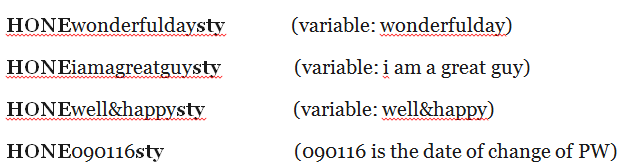
6         I can add a small trick so that the actual PWs become unreadable:Drop vowels
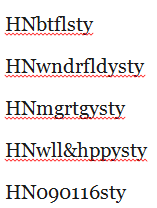
What I have done is to leave out all the vowels.

7          So, all I have to remember is the constant-word ‘honesty’.  This way, I can safely write down the variable-words somewhere.  My list will look something like this:Variables
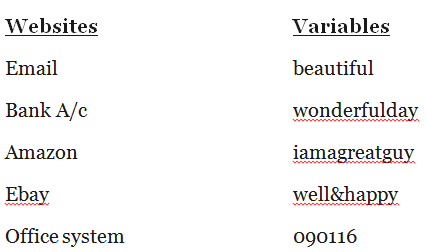
I will write the words in their complete forms although I know that the PWs do not contain the vowels.

8          The last example has a mix of alphanumeric characters and this makes the PW even stronger.  Hence, it might be a good idea to use a number instead for the variable.  Apart from dates, numbers may also be derived from words based on the number counts of the letters in them:Words to Nos
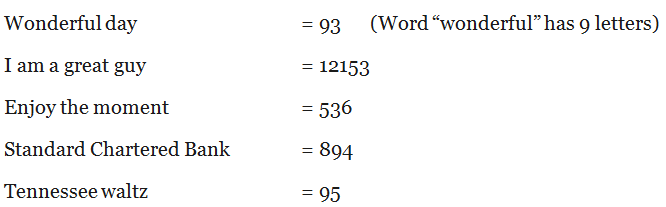
So what are written down are the word phrases that provide the number codes.  As can be seen above, the word phrase can also be a public company or a song title.

9        If you are not comfortable with keeping such a list, you can make the list misleading by throwing in some red herrings in the entries.  See the post entitled “Red Herrings” what this means.

 The Constant

10       The word for the constant is the secret part of the PWs.  It is not to be written down.  To make it easy for you to recall, use a word that you will never forget because it has a special significance to you and nobody knows it.  It may be a word that represents the moral principle you uphold, like honesty.  Or, the name of a grandfather or grandmother or other favourite relative, a favourite flower, hero, pet, cartoon character, the first model of car you owned, zodiac/animal sign, DOB in words, etc.  Use the imagination and you should be able to come up with a unique one that nobody can guess.

11        Alternatively, a number can be used as a constant.  Use one with at least 3 digits and split it into 2 parts for a prefix and a suffix.  If you do not have a number that is of special significance to you, you can use a word suggested in the previous paragraph and convert it into a number.  Para 14 gives an example of how we can derive a number from a word.

12        For those who know Chinese, they can use a Chinese character or two to represent their constant.  I know of two ways to derive numbers from Chinese characters.  The easier way is the number of strokes that make up the Chinese character.  Since the stroke count for a character will at most be a 2-digit number, then use two characters, one for prefix and another for suffix.  The second way is to use the 4 digits from the 4-corner dictionary code.  For example, the code for the character for ‘happy’ 樂 is 2290.  (More of this in the post Coding With Chinese Characters.)


PIN Numbers

13        For PINs, the constant will of course have to be a number.  Like the constant for the PW, it’s a number that you will never forget and thus does not need to be written down.  Part of this number will be a prefix and the rest a suffix.

14        To save from having to think of another constant for PIN, you can use the PW constant to work out a number associated with it.  One method is to assign a number to each letter of the alphabet based on its position in the alphabet.  A number can then be derived for any word by adding the numbers represented by the letters that make up the word.  For example, the word ‘honesty’ will be the sum 8+15+14+5+19+20+25 giving the number ‘106’.   By this method, the word ‘honesty’ is my constant for both PWs and PINs.   I can use ‘honesty’ for PWs and ‘106’ for PINs, or I can use ‘106’ for both.

15        For those who use a Chinese character to represent their password constant, they can obviously use it for PINs as well

16       For the variable, just add a number to make up the number of digits required for the particular PIN.  Just like for PWs, it is quite safe to write down the variables in a list for reference, as long as the constant is not written down anywhere – it is strictly only in the memory.

17        It is also important to remember the method you have decided for your coding.  I have given several examples of how we can encode the constant and the variables.  You should use a coding method for variables different from that used for the constant so that there will be a alphanumeric mix.  Decide on just one combination of methods to use and stick to it.   We want the system to be effective and yet simple enough to apply and remember.

18        I have not included the use of special characters like ~ ! @ # %, etc.  This is because many websites/portals do not accept such characters in the PWs.  If it is one that does, they can be included in the constant, and make a note of it in the relevant variable, such as:

I am a great guy!

An exclamation mark is added as a prompt to indicate that a special character is included in the PW but the actual special character is something else.

© Lim Jun Han