
In the post Creating Secure Passwords and PINs Easily, mention is made that Chinese characters may be used to represent our constant. For our purpose, Chinese characters represent numbers in two ways. One is stroke count and the other is the 4 digits from the 4-corner dictionary code. For example,
The 4-corner code has the advantage in that the 4 digits will come to mind quickly once you are familiar with the system. I would like to give more ideas on how we can use it for our purpose.
First, a reference chart on the 4-corner code or the 4-corner numbers character lookup system (四角號碼檢字法):

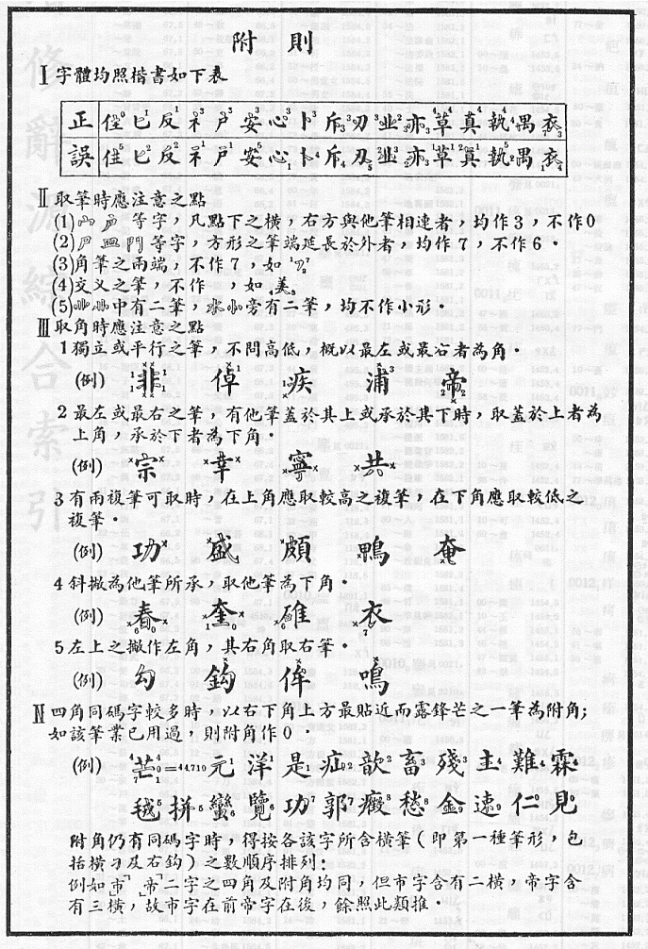 Source: http://geostroke_abc.tripod.com/ChineseDigitalResearch.html)
This one for download into mobile phones for reference:

For those new to this system, there are many sites they can learn from. These are some of them:
http://dict.variants.moe.edu.tw/fulu/fu13/fubiau/four.htm
http://baike.so.com/doc/5430747-5669032.html
http://baike.baidu.com/view/67253.htm
http://www.baike.com/wiki/%E5%9B%9B%E8%A7%92%E5%8F%B7%E7%A0%81
This site gives the 4-digit numbers when you input the characters:
When I introduced this method it was in the context of using a Chinese character or two to represent the constant. Actually, we can use Chinese characters for variables too. However, to ensure that there is a mix of alphanumeric characters, we cannot have both the constant and the variables represented by Chinese characters for passwords. (There is of course no such constraint in the case of PINs.)
I would like to advocate this strategy for those who read Chinese. Construct your constant to contain alphabets and use Chinese characters for the variables. The list of variables you keep will thus consist of Chinese characters. If you go one step further, if the Chinese characters come from the Chinese names of the websites or the organisations to which the websites belong, you can even dispense with keeping a list. For example:
In the above examples, I use the first character of the name as my variable character. This is a rule I have set to apply in all cases. With this I can dispense with the need to keep a record of the variables. You can of course set a different rule, such as, taking the last character instead.
The 4-corner code system was first publicized in the 1920s by Wang Yunwu (王雲五), the editor-in-chief at Commercial Press Ltd, China. There is now a fifth digit added to take account of certain stroke inside the character. There are also variations of the system adapted for some specific uses, see http://geostroke_abc.tripod.com/ChineseDigitalResearch.html.
All these systems are meant for dictionary listings of the characters. For our purpose, we just want the number codes and this system suits us to a T.
In conclusion, I would like to point out that this website will probably be known to hackers and cyber thieves. They will take note of this method. The primary strength of this method lies in the constant. We must make sure that it is never compromised and never something they can guess.
 Create secure passwords and PINs